
CHAPTER 01
Introducing the Voxel AI Network
1.1Overview
The Voxel AI Network is a decentralized 3D compute and AI rendering infrastructure network, built to deliver open compute capacity to global markets in AI training, 3D data processing, digital rendering, and spatial computing.
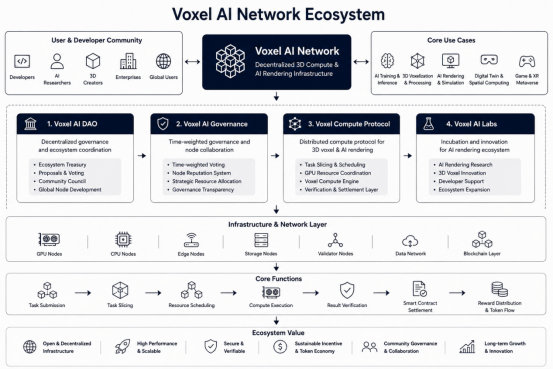
As artificial intelligence, multimodal models, digital twins, virtual reality, and spatial computing advance rapidly, global demand for 3D voxel data processing and AI rendering compute continues to grow. Yet high-performance GPU and 3D rendering resources remain concentrated in a handful of large cloud platforms and specialized institutions, making it hard for small and mid-sized developers, independent creators, and on-chain AI projects to access stable compute at low cost.
The Voxel AI Network introduces decentralized infrastructure centered on AI rendering and voxelized compute, coordinating GPU resources, AI model training, 3D rendering workloads, and an on-chain compute marketplace.
The four core layers of the Voxel AI Network ecosystem:
- Voxel AI DAO: responsible for network governance, ecosystem funding coordination, and global node growth.
- Voxel AI Governance: steers AI compute resources and ecosystem strategy through time-weighted governance and node coordination.
- Voxel Compute Protocol: a distributed compute protocol for 3D voxelized compute and AI rendering markets.
- Voxel AI Labs: an incubation system for ecosystem expansion and AI rendering innovation.
The Voxel AI Network operates as an integrated AI rendering and 3D compute ecosystem composed of several core layers. Each layer carries distinct responsibilities within the network, and together they drive:
- GPU compute coordination
- AI model training and inference
- 3D voxelized rendering
- Node rewards and Token circulation
- Governance collaboration and ecosystem expansion
As the AI and spatial computing industries continue to evolve, the Voxel AI Network aims to build an open, transparent, and sustainable global infrastructure network for 3D AI.
1.2Core Philosophy
The foundational ideas guiding the Voxel AI Network include: an AI rendering focus, decentralized governance, structural transparency, compute coordination, and long-term infrastructure building.
The architecture and ecosystem development of the Voxel AI Network are organized around the following core principles.
1) Focus on AI and 3D Compute
The Voxel AI Network is dedicated to AI rendering, voxelized compute, and 3D data processing.
The network prioritizes:
- 3D voxel rendering
- AI model training
- Digital twin compute
- Spatial data processing
- Multimodal AI inference
This focus keeps the entire ecosystem anchored to the AI and spatial computing markets, without drifting from its core infrastructure positioning.
2) Governance-Driven Direction
The strategic direction of the Voxel AI Network is decided through on-chain governance.
vAToken holders, GPU nodes, and long-term ecosystem participants collectively decide:
- Resource allocation priorities
- Node coordination rules
- Protocol upgrade paths
- AI ecosystem partnership programs
Governance power flows through community coordination rather than concentrating in any single institution.
3) Structural Transparency
Node rewards, task allocation, governance decisions, and DAO fund flows are all publicly recorded through on-chain mechanisms.
In the Voxel AI Network, transparency is treated as foundational infrastructure — not merely a marketing tool.
4) Compute Coordination and Resource Discipline
All GPU and AI resource allocation is executed through the Voxel Scheduler and the on-chain verification system.
Resource deployment prioritizes:
- Long-term AI ecosystem value
- 3D compute demand
- Network stability
- Distributed resource utilization efficiency
— not short-term market speculation.
5) Modular Coordination
The Voxel AI DAO, Voxel Compute Protocol, vAToken, and Voxel AI Labs operate as distinct components of a single unified system.
AI training, rendering compute, GPU scheduling, and governance work in concert to drive the expansion of the entire ecosystem.
6) Long-Term AI Infrastructure Orientation
The Voxel AI Network is designed as long-term infrastructure for AI and spatial computing.
Strategic decisions focus on:
- Long-term GPU resource collaboration
- AI rendering market growth
- 3D data infrastructure
- Distributed spatial computing ecosystems
— not cyclical market swings.
1.33D Voxelized Compute Strategy
1) Market Thesis
The Voxel AI Network focuses on 3D voxelized compute and AI rendering markets.
As AI video generation, spatial computing, digital twins, and XR (extended reality) ecosystems grow rapidly, global demand for 3D spatial data and real-time AI rendering capability is accelerating.
The goal of the Voxel AI Network is to become the core GPU coordination network within future spatial AI infrastructure.
2) Core Thesis
Voxel computing represents a new compute paradigm suited to 3D spatial data processing and AI rendering.
Unlike traditional 2D pixel processing, a voxel can record, within three-dimensional space:
- Depth
- Position
- Structural information
- Dynamic change data
This structure is better aligned with the future direction of AI and spatial computing.
The Voxel AI Network is dedicated to this domain.
3) Why Voxelized Compute
A growing share of future AI systems will move from 2D information processing toward 3D spatial understanding.
Including:
- Autonomous driving
- Digital twins
- XR spatial interaction
- AI video generation
- Robotic spatial perception
- Real-time metaverse rendering
These scenarios all require AI that understands real spatial structure — and voxelized data is a critical foundation for building 3D AI world models.
Through GPUs and a distributed rendering network, the Voxel AI Network aims to provide the underlying infrastructure for this shift.
4) Industry Scope
The Voxel AI Network focuses on core infrastructure within the AI and spatial computing ecosystem.
Including:
- 3D voxelized rendering
- AI video generation
- Spatial computing model training
- Digital twin systems
- GPU rendering networks
- AI inference and edge rendering
- XR and real-time spatial interaction
- 3D AI data training systems
Expansion beyond this scope requires DAO governance approval.
5) Strategic Orientation
3D AI and spatial computing are long-term infrastructure markets.
The long-term strategic priorities of the Voxel AI Network include:
- Global GPU node expansion
- AI rendering market development
- Multi-chain AI resource coordination
- Distributed 3D compute protocols
- AI spatial model training ecosystems
6) Compute Resource Phases
GPU and edge rendering resources will become the core foundational resources of future spatial AI.
The Voxel AI Network will prioritize:
- High-performance GPU network buildout
- AI rendering node collaboration
- Distributed inference systems
- Real-time spatial computing infrastructure
7) Resource Allocation Framework
All GPU resources and AI rendering task allocation follow the DAO and on-chain governance framework.
This structure ensures:
- Transparent compute allocation
- Verifiable GPU contribution
- Quantifiable AI rendering revenue
- Long-term stable resource scheduling
— and stays aligned with the long-term infrastructure goals of the entire Voxel AI Network.
1.4The AI Rendering and Distributed Training Ecosystem
The Voxel AI Network builds an open GPU coordination ecosystem for AI rendering and distributed training.
Traditional AI training and rendering systems typically rely on centralized GPU clusters. This structure suffers from:
- High GPU costs
- Limited scalability
- Compute concentration
- High barriers to AI resources
and related problems.
Through a distributed GPU coordination structure, the Voxel AI Network enables GPU nodes worldwide to collectively participate in:
- AI video generation
- 3D voxel rendering
- Spatial AI model training
- Multimodal data processing
- AI inference services
The entire ecosystem is managed by the Voxel Scheduler, a dynamic scheduling engine.
Large AI rendering jobs are split into multiple parallel compute units and distributed to GPU nodes around the world for simultaneous execution — improving overall rendering efficiency and reducing single-point resource pressure.
The Voxel AI Network also supports:
- Multi-model parallel training
- Distributed AI inference
- Edge rendering networks
- AI Agent real-time compute
- Multi-chain AI resource coordination
All task execution results are confirmed through the on-chain verification system and mapped into the vAToken rewards model.
GPU node rewards are bound to the following factors:
- AI rendering contribution
- GPU resource consumption
- Uptime stability
- Verification success rate
- Participation in spatial computing tasks
The goal of the Voxel AI Network is not merely to build an AI GPU network, but to construct the underlying infrastructure for future spatial AI and 3D intelligent computing.
As AI video, XR, and digital twin markets continue to expand, the Voxel AI Network aims to grow into a global AI rendering and spatial computing ecosystem.
CHAPTER 02
Voxel AI DAO
2.1The AI Compute Treasury
The Voxel AI DAO is the core governance and resource coordination body of the Voxel AI Network, responsible for managing GPU compute resources, AI rendering funds, ecosystem expansion budgets, and long-term infrastructure buildout across the ecosystem.
As AI video generation, spatial computing, and 3D rendering markets continue to grow, GPUs and high-performance compute are becoming core resources of the future AI economy. Traditional AI infrastructure relies on centralized cloud platforms to control resources and pricing. The Voxel AI DAO's goal is to build an open, transparent, and sustainable AI compute treasury through on-chain governance and community coordination.
The Voxel AI DAO treasury is organized around the following areas:
- GPU node incentives
- AI rendering task settlement
- Spatial computing ecosystem expansion
- AI Labs R&D support
- Multi-chain ecosystem collaboration
- Long-term DAO reserve management
All treasury resources are publicly recorded through on-chain structures. DAO treasury wallets, fund flows, and resource deployments can be queried in real time through the governance portal.
Core funding sources for the Voxel AI DAO include:
- Fees from AI rendering and training tasks
- Resource usage fees from the Voxel Compute Protocol
- GPU node coordination revenue
- Cross-chain AI service income
- Ecosystem partnerships and protocol revenue
This income is not controlled by any single institution; it flows into the DAO treasury, and subsequent allocation is decided through governance.
The Voxel AI DAO's treasury structure emphasizes a long-term AI infrastructure orientation.
Resource allocation prioritizes:
- GPU node network expansion
- AI rendering market development
- The 3D spatial computing ecosystem
- Distributed inference services
- Developer tooling and protocol optimization
— not short-term market behavior.
The treasury also adopts a risk-tiered structure.
A portion of funds is allocated to:
- Network security reserves
- Node incident compensation
- Protocol vulnerability remediation
- A long-term ecosystem stability fund
Another portion drives:
- AI project partnerships
- GPU infrastructure expansion
- Global node growth
- Labs R&D support
The long-term goal of the Voxel AI DAO is to form an open AI compute treasury driven jointly by AI rendering demand, GPU resource collaboration, and on-chain governance.
As global AI and spatial computing markets continue to expand, the Voxel AI DAO aims to become a core resource coordination layer in future AI infrastructure.
2.2Genesis Nodes and GPU Onboarding
Genesis Nodes are the core GPU infrastructure of the Voxel AI Network in its early phase and a vital part of the entire AI rendering and voxelized compute ecosystem.
In the network's early stage, Genesis Nodes are responsible for:
- AI rendering task execution
- 3D spatial data processing
- Distributed model training
- On-chain verification tasks
- Network stability maintenance
Genesis Nodes typically consist of high-performance GPU clusters with stable network environments and long-term operational capability.
The Voxel AI Network adopts an open GPU onboarding model.
Any GPU device that meets the protocol standard can join the network through Voxel Node Core and participate in AI rendering and spatial computing tasks.
The system automatically detects:
- GPU performance
- VRAM capacity
- CUDA compute capability
- Network bandwidth
- Node stability
and generates an on-chain node profile.
Different GPU nodes carry different task tiers within the network.
High-performance GPU nodes typically handle:
- AI video generation
- Large model training
- 3D voxelized rendering
- Multimodal spatial computing
Lightweight GPUs and edge nodes primarily participate in:
- AI inference
- Real-time rendering
- Edge spatial computing
- Distributed auxiliary tasks
The Voxel Scheduler dynamically allocates resources based on node performance and task demand, maximizing GPU utilization across the network.
Genesis Nodes also carry verification and stability responsibilities within the network.
Some Genesis Nodes participate in network operations as:
- Validator Nodes
- Scheduling assist nodes
- AI rendering sync nodes
To ensure long-term network stability, Genesis Nodes are typically required to stake vAToken and are managed by the on-chain reputation system.
Genesis Nodes that run stably over the long term gradually earn:
- Higher task priority
- Eligibility for high-tier GPU tasks
- DAO governance weight
- A higher share of rewards
Through the Genesis Node system, the Voxel AI Network aims to progressively build global GPU rendering and spatial computing infrastructure, driving the evolution of AI rendering resources from centralized platforms toward an open, coordinated network.
2.3SubDAOs and Regional Node Committees
As the Voxel AI Network's global node footprint grows, a single governance structure can no longer meet the long-term needs of the AI rendering and spatial computing ecosystem.
The Voxel AI DAO therefore introduces SubDAOs and a regional node committee system to drive layered governance across global GPU nodes, regional communities, and AI ecosystem collaboration.
A SubDAO is a regionalized and functional governance extension of the Voxel AI DAO.
Different SubDAOs can build independent governance systems around:
- The AI rendering ecosystem
- GPU node operations
- XR and spatial computing
- The developer ecosystem
- Edge AI networks
- Regional market expansion
Each SubDAO can independently advance local ecosystem building and resource collaboration under the main DAO governance framework.
Regional node committees are primarily responsible for:
- GPU node coordination
- Regional resource scheduling
- Local node growth
- Community governance collaboration
- Network stability maintenance
Committees in different regions can craft node strategies better suited to regional development, based on local GPU resources and AI market demand.
Through this layered governance structure, the Voxel AI DAO enables regions worldwide to participate more flexibly in building future AI infrastructure.
SubDAOs and regional committees operate under a collaborative governance model.
Regional committees run local ecosystems, while major protocol upgrades, Token mechanism changes, and core resource governance still require a main DAO vote.
SubDAOs are also a key expansion path for future AI Labs and the developer ecosystem.
Different technical teams and developer communities can build independent SubDAO ecosystems around:
- AI video generation
- 3D voxel engines
- Spatial AI models
- XR rendering protocols
- AI Agent networks
This structure continuously strengthens the scalability and global collaboration capacity of the entire Voxel AI Network.
As the global AI and spatial computing ecosystem grows, SubDAOs and regional node committees will become an important governance foundation for the long-term expansion of the Voxel AI Network.
2.4On-Chain Governance and Legal Structure
The Voxel AI Network adopts on-chain governance combined with a multi-layer legal structure, ensuring that the AI rendering and spatial computing ecosystem can operate reliably over the long term in an open, collaborative environment.
As global GPU nodes, AI Labs, and the cross-chain ecosystem continue to expand, the scale of resources, governance complexity, and economic structure of the network all keep growing. The Voxel AI Network therefore builds long-term, trusted AI infrastructure through transparent governance and a compliant structure.
The governance core of the Voxel AI DAO is based on:
- On-chain proposals
- Community voting
- Node governance weight
- The veToken model
- A multisig execution mechanism
All governance processes run publicly with on-chain records.
This includes:
- Proposal content
- Voting processes
- DAO treasury usage
- Node governance outcomes
- Protocol upgrade records
Any participant can publicly view and verify them.
The Voxel AI DAO's governance structure emphasizes:
- Decentralized collaboration
- Long-term GPU infrastructure building
- Transparent AI ecosystem management
- Community-consensus-driven development
Governance weight is tied not only to Token holdings; it is also deeply bound to:
- GPU node contribution
- AI rendering participation
- Node stability
- Long-term staking
To strengthen protocol security, the Voxel AI DAO adopts a multisig governance structure.
Core protocol upgrades, treasury spending, and key parameter adjustments can only be executed after multisig verification.
On the legal side, the Voxel AI Network adopts layered governance and a protocol-based operating model.
The DAO is responsible for:
- Community governance
- Node collaboration
- Ecosystem resource coordination
while concrete AI R&D, infrastructure operations, and regional partnerships can be advanced through independent entities or regional SubDAOs.
This structure reduces centralization risk and strengthens global ecosystem scalability.
The long-term goal of the Voxel AI Network is to progressively evolve the entire AI rendering and spatial computing network toward full community autonomy.
CHAPTER 03
The Voxel AI Governance System
3.1Governance Framework
The governance system of the Voxel AI Network is designed to establish a long-term, stable coordination structure for global AI rendering, 3D voxelized compute, and the GPU node network. As AI infrastructure evolves toward open, distributed networks, traditional centralized governance models can no longer support global node coordination and multi-chain ecosystem expansion. The Voxel AI Network therefore adopts a decentralized on-chain governance framework that lets ecosystem participants collectively drive the network's long-term development.
Voxel AI Governance is the core governance layer of the ecosystem, coordinating:
- GPU node resources
- AI rendering ecosystem expansion
- DAO treasury management
- Protocol upgrade direction
- Multi-chain ecosystem collaboration
- AI Labs R&D support
The core goal of the governance system is not Token voting alone, but the creation of a long-term AI infrastructure coordination system.
Voxel AI Governance is composed primarily of:
- Voxel AI DAO
- Regional node committees
- SubDAO ecosystem organizations
- The GPU node governance layer
- The veToken holder governance layer
- The AI Labs coordination layer
Each governance layer carries distinct responsibilities within the ecosystem, and together they keep the entire network running.
The design philosophy of Voxel AI Governance emphasizes:
1) Long-Term GPU Infrastructure Orientation
Governance decisions prioritize:
- AI rendering resource expansion
- Spatial computing network buildout
- Long-term GPU node stability
- The distributed AI training ecosystem
— not short-term market behavior.
2) Contribution-Driven Governance
Governance power derives not only from Token holdings; it is also deeply bound to:
- GPU compute contribution
- Node uptime stability
- AI rendering participation
- Long-term staking duration
3) Transparent Governance Structure
All governance proposals, voting processes, and execution outcomes are publicly recorded through on-chain systems.
Transparency is treated as an integral part of governance infrastructure.
4) Layered Governance Coordination
The main DAO, SubDAOs, and regional committees operate under a layered, coordinated governance structure.
Regional ecosystems can develop autonomously, while core protocol upgrades still require network-wide governance.
5) Long-Term Ecosystem Autonomy
The ultimate goal of Voxel AI Governance is to progressively bring community self-governance to the entire AI rendering and spatial computing ecosystem.
As global GPU nodes continue to grow, more resource scheduling and ecosystem direction will be decided collectively by the community.
3.2The On-Chain Governance Process
The governance process of the Voxel AI Network uses on-chain proposals and collaborative community decision-making, ensuring that GPU resources, AI rendering markets, and protocol upgrades operate in an open and transparent environment.
The core goal of the governance process is to let the nodes, developers, and community members who build the ecosystem over the long term jointly shape the future direction of AI infrastructure.
The on-chain governance process of Voxel AI Governance mainly includes:
- Proposal submission
- Community discussion
- On-chain voting
- Multisig confirmation
- Protocol execution
- On-chain record archiving
All governance processes run through on-chain structures, with records preserved permanently.
1) Proposal Submission
Any participant who meets the governance eligibility requirements can submit a governance proposal to the DAO.
Proposals typically cover:
- GPU node rule adjustments
- AI rendering protocol upgrades
- DAO treasury allocation
- Voxel Compute Protocol parameter changes
- AI Labs partnership programs
- Cross-chain ecosystem expansion plans
Different types of proposals enter different governance tracks based on their scope of impact.
2) Community Discussion
After submission, a proposal enters a community discussion period.
GPU nodes, developers, SubDAOs, and veToken holders can openly discuss:
- Impact on AI rendering resources
- GPU scheduling efficiency
- Network stability
- The Token economic model
The goal of this stage is to improve governance transparency and community coordination.
3) On-Chain Voting
Once discussion concludes, the proposal enters the on-chain voting process.
Voting weight is primarily based on:
- vAToken holdings
- veToken lock duration
- GPU node contribution
- Node reputation tier
Nodes that participate in the ecosystem stably over the long term typically carry greater governance weight.
4) Multisig Confirmation
Proposals involving core protocol upgrades, treasury spending, and cross-chain structural changes also require confirmation through the multisig mechanism.
This structure effectively reduces single-point governance risk.
5) Protocol Execution
Once a governance proposal passes, smart contracts automatically execute the corresponding parameter changes and resource scheduling logic.
All execution results are recorded on-chain in sync.
Through this on-chain governance process, Voxel AI Governance aims to build an AI infrastructure governance system that is:
- Verifiable
- Auditable
- Sustainably collaborative
3.3Node Governance Types
As GPU nodes, AI rendering tasks, and spatial computing scenarios multiply across the Voxel AI Network, the network has evolved a multi-layer node governance structure.
Different nodes carry different responsibilities within the ecosystem. Voxel AI Governance therefore divides node governance into multiple types, improving the coordination efficiency and stability of the entire AI rendering network.
1) GPU Rendering Node Governance
GPU rendering nodes are the core compute resource of the network.
They are primarily responsible for:
- AI video generation
- 3D voxel rendering
- Large model training
- Spatial AI inference
GPU node governance centers on:
- Compute resource scheduling
- AI rendering reward distribution
- The GPU node reputation system
- High-performance resource management
GPU nodes that run stably over the long term gradually gain greater governance influence.
2) Validator Node Governance
Validator Nodes are responsible for:
- AI rendering result verification
- GPU task validation
- On-chain data confirmation
- Anomaly detection
Validator node governance places greater emphasis on:
- Network security
- Verification efficiency
- On-chain trustworthiness
- Risk control mechanisms
Certain high-tier Validator Nodes are required to stake vAToken over the long term.
3) Edge Node Governance
Edge nodes are primarily responsible for:
- Real-time spatial inference
- XR edge rendering
- IoT spatial computing
- AI Agent coordination
Edge node governance emphasizes:
- Low-latency compute
- Regional coordination capability
- Distributed stability
- Real-time AI service efficiency
As the spatial computing market develops, the importance of edge nodes will keep rising.
4) SubDAO Node Governance
Different regions and AI Labs communities can establish independent node governance structures through SubDAOs.
SubDAO node governance typically centers on:
- Regional GPU resources
- Local developer ecosystems
- AI Labs projects
- Spatial computing infrastructure
SubDAOs enjoy substantial autonomy in local governance, but core protocol upgrades still go through the main DAO.
5) Governance Node Coordination
These node governance structures do not operate in isolation; they work together under a unified governance framework.
GPU nodes, Validator Nodes, edge nodes, and SubDAOs together form the governance foundation of the entire Voxel AI Network.
This multi-layer node governance system enables the AI rendering and spatial computing ecosystem to expand stably worldwide over the long term.
3.4The vAToken veToken Model
The vAToken veToken (Vote Escrow Token) model is a key governance and long-term coordination mechanism within Voxel AI Governance.
The veToken model aims to unify the following into a single governance structure:
- Long-term GPU infrastructure building
- AI rendering resource collaboration
- Community governance participation
- Long-term node stability
In traditional Token models, governance power depends entirely on the number of Tokens held, which allows short-term market behavior to exert outsized influence on governance.
Through the veToken mechanism, the Voxel AI Network strengthens the governance influence of long-term ecosystem participants.
Users can obtain vevAToken by locking vAToken.
The longer the lock, the greater the veToken weight.
vevAToken is primarily used for:
- DAO voting
- GPU node governance
- AI rendering resource allocation
- SubDAO weight coordination
- AI Labs proposal participation
- Treasury governance decisions
The governance logic of veToken emphasizes:
1) Long-Term Orientation
Long-term lockers hold greater governance weight.
This mechanism encourages the community to participate in AI infrastructure building over the long term.
2) Governance Bound to Contribution
Governance power is tied not only to the amount locked; it also works in concert with:
- GPU node contribution
- AI rendering participation
- Node reputation tier
3) Ecosystem Coordination Incentives
Participants who remain engaged over the long term in:
- GPU node operations
- AI Labs development
- Spatial computing ecosystem building
gradually gain greater governance influence.
4) A Stable Governance Structure
The veToken model reduces the impact of short-term market volatility on governance and strengthens the long-term stability of the entire ecosystem.
Through the veToken model, the Voxel AI Network aims to build a global governance system that is:
- Long-term stable
- Decentralized and collaborative
- AI-infrastructure-oriented
As the ecosystem expands, vevAToken will become an increasingly important foundation for governance and resource coordination across the Voxel AI Network.
CHAPTER 04
Voxel Compute Protocol Overview
4.1Protocol Goals
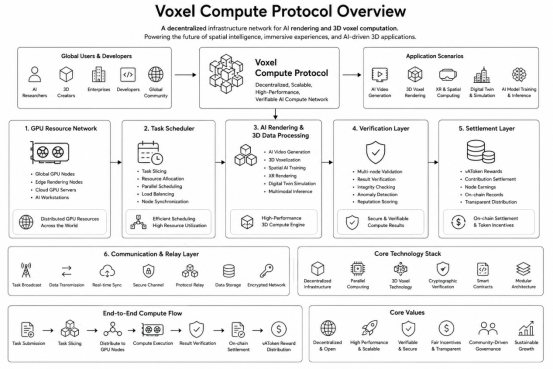
The Voxel Compute Protocol is the core distributed compute protocol of the Voxel AI Network, coordinating GPU nodes worldwide, AI rendering resources, and 3D voxelized compute tasks.
As AI video generation, spatial computing, digital twins, and XR ecosystems grow rapidly, a growing share of future AI systems will move beyond 2D information processing and need to continuously handle:
- 3D spatial data
- AI rendering tasks
- Multimodal model training
- Real-time spatial inference
- Edge compute coordination
Traditional centralized GPU infrastructure has clear limitations in scalability, resource utilization, and global coordination.
The goal of the Voxel Compute Protocol is to build a global AI rendering and spatial computing network that is:
- Decentralized
- Scalable
- High-performance
- Verifiable
The protocol's long-term mission includes:
- Unifying global GPU resources into a single AI compute network
- Driving standardization of 3D voxelized data processing
- Building an open AI rendering marketplace
- Lowering barriers to AI and spatial computing resources
- Deepening the integration of AI and Web3 infrastructure
The protocol's core operating directions center on:
1) GPU Resource Coordination
The protocol allows GPU nodes worldwide to join the network under a unified standard and dynamically participate in AI rendering and spatial computing tasks.
2) AI Rendering Infrastructure
The protocol supports scenarios including:
- AI video generation
- 3D scene rendering
- XR spatial computing
- Digital twin simulation
- Multimodal AI inference
3) Distributed Task Execution
Large AI and spatial computing tasks are split into multiple parallel task units and executed simultaneously by different GPU nodes.
4) On-Chain Verification and Reward Settlement
All GPU task results are confirmed through the on-chain verification system and mapped into the vAToken rewards model.
5) Long-Term AI Infrastructure Building
The Voxel Compute Protocol is more than a GPU scheduling system; it is a foundational protocol for the future spatial AI and 3D intelligence ecosystem.
As global AI rendering demand continues to grow, the Voxel Compute Protocol aims to become the core compute layer of the next generation of AI and spatial computing networks.
4.2The Voxel Core Compute Architecture
The Voxel Compute Protocol adopts a distributed 3D compute architecture that supports the coordinated execution of AI rendering, voxelized data processing, and spatial computing tasks across a global GPU network.
The protocol architecture consists of the following core layers:
- GPU Node Layer
- Voxel Scheduler Layer
- Voxel Rendering Layer
- Verification Layer
- Settlement Layer
- Relay Layer
Together, these layers form complete AI rendering and spatial computing infrastructure.
1) GPU Node Layer
The GPU Node Layer is the core compute resource layer of the network.
Nodes can consist of:
- High-performance GPU clusters
- Cloud GPU servers
- Edge rendering devices
- AI workstations
GPU nodes are responsible for:
- AI video generation
- 3D voxel rendering
- Spatial model training
- Multimodal inference
- Real-time AI rendering
The system automatically assigns node tiers based on GPU performance.
2) Voxel Scheduler Layer
The Voxel Scheduler is the protocol's core scheduling system.
Its primary responsibilities include:
- AI task slicing
- GPU resource allocation
- Parallel task scheduling
- Load balancing
- Node synchronization
Large rendering tasks are automatically split and distributed to different GPU nodes for simultaneous execution.
3) Voxel Rendering Layer
The Voxel Rendering Layer is responsible for:
- 3D voxel data processing
- AI scene generation
- XR spatial rendering
- Digital twin graphics compute
This layer supports:
- Multimodal AI data structures
- Real-time spatial data synchronization
- GPU parallel rendering
- Dynamic 3D spatial computation
4) Verification Layer
The Verification Layer is responsible for:
- Rendering result verification
- GPU output validation
- AI model result synchronization
- Anomaly detection
All task results must pass on-chain verification before entering the settlement process.
5) Relay and Settlement Layers
The Relay Layer handles:
- Node communication
- GPU data synchronization
- Rendering task broadcast
The Settlement Layer is responsible for:
- vAToken reward distribution
- GPU contribution settlement
- Node reward recording
The entire architecture follows a modular design.
Different AI rendering modules and spatial computing protocols can be continuously extended through standardized interfaces without modifying the underlying protocol structure.
Through this architecture, the Voxel Compute Protocol aims to establish long-term infrastructure for global AI rendering and 3D computing.
4.3AI Rendering and 3D Data Processing
AI rendering and 3D data processing are the core operating directions of the Voxel Compute Protocol.
Future AI systems will gradually shift from 2D content generation toward:
- 3D spatial understanding
- AI video generation
- XR spatial interaction
- Digital twin simulation
- Spatial AI inference
These scenarios all continuously consume large amounts of GPU and high-performance rendering resources.
Through its global GPU network, the Voxel Compute Protocol enables distributed AI rendering and coordinated 3D data processing.
The protocol's AI rendering system primarily supports:
1) AI Video Generation
AI video generation typically requires:
- Multi-frame spatial modeling
- Dynamic lighting computation
- GPU parallel inference
- Large-scale model training
The Voxel Protocol splits these tasks across different GPU nodes for simultaneous execution.
2) 3D Voxelized Data Processing
A voxel is the smallest data unit in three-dimensional space.
Compared with 2D pixel structures, voxels can record:
- Depth
- Spatial position
- Structural change
- 3D dynamic information
This structure is better suited to:
- Spatial AI
- XR rendering
- Autonomous driving
- Digital twins
- Robotic spatial perception
3) Spatial AI Model Training
The Voxel Protocol supports:
- 3D spatial model training
- Multimodal AI inference
- XR spatial understanding
- Real-time scene analysis
GPU nodes can jointly participate in large-scale spatial AI model training tasks.
4) Edge Rendering and Real-Time Inference
Edge nodes can participate in:
- Real-time spatial rendering
- AI Agent inference
- XR edge computing
- Mobile AI services
thereby reducing pressure on centralized GPUs.
5) AI Data Coordination
The Voxel Protocol supports:
- Distributed 3D data synchronization
- GPU rendering data sharing
- AI model parameter coordination
- Spatial computing task synchronization
Through its AI rendering and 3D data processing systems, the Voxel AI Network is driving AI's transition from the era of 2D information into the era of 3D spatial intelligence.
4.4Distributed Task Verification
To guarantee the trustworthiness of the entire AI rendering and spatial computing network, the Voxel Compute Protocol implements a distributed task verification mechanism.
In an open GPU network without a unified verification structure, some nodes could undermine network stability through:
- Fake rendering
- GPU cheating
- Data tampering
- Submitting anomalous results
The Voxel Protocol therefore introduces on-chain verification and a multi-node validation system.
After completing a task, every GPU node must submit:
- A rendering result hash
- Proof of GPU resources
- AI output records
- The task execution path
and enter the verification process.
The distributed verification system mainly includes:
1) Multi-Node Cross-Verification
Different Validator Nodes simultaneously verify:
- AI rendering results
- 3D data structures
- GPU output content
2) On-Chain Attestation
All critical task records generate on-chain data.
This includes:
- GPU contribution records
- AI rendering tasks
- Node rewards
- Verification results
Any participant can query them publicly.
3) Anomaly Detection
The system continuously monitors:
- GPU fluctuation
- Anomalous rendering results
- Node behavior patterns
- Data consistency
Anomalous nodes are subject to measures such as:
- Reward restrictions
- Node downgrading
- Staking penalties
4) Dynamic Verification Weight
GPU nodes and Validator Nodes that run stably over the long term gradually earn higher verification weight.
5) On-Chain Reward Settlement
Once task verification completes, the system automatically distributes vAToken rewards based on:
- GPU resource consumption
- AI rendering contribution
- Node stability
Through this distributed verification system, the Voxel Compute Protocol aims to build a global AI rendering and spatial computing network that is:
- Verifiable
- Traceable
- Quantifiable
CHAPTER 05
Voxel AI Labs
5.1Labs Positioning
Voxel AI Labs is the experimental arm of the Voxel AI Network responsible for AI rendering R&D, spatial computing innovation, and ecosystem expansion, with the goal of driving the continuous evolution of 3D AI, voxelized compute, and the distributed GPU network.
As AI video generation, XR spatial interaction, digital twins, and multimodal models advance rapidly, future AI infrastructure will need not only GPU compute but also continuous algorithm optimization, spatial data research, and AI rendering innovation.
Voxel AI Labs was established in this context as an open AI experimentation and ecosystem coordination platform.
The core responsibilities of Voxel AI Labs include:
- AI rendering protocol R&D
- 3D voxelized compute research
- Spatial AI model training
- GPU rendering optimization
- AI Agent system experimentation
- XR and edge spatial computing exploration
Labs is more than a single R&D department; it is the technology innovation and ecosystem expansion hub of the entire Voxel AI Network.
The long-term goal of Voxel AI Labs is to build a global AI experimentation network centered on:
- Spatial AI
- AI video generation
- XR rendering
- 3D data processing
- Distributed GPU coordination
Research at Voxel AI Labs focuses primarily on:
1) AI Rendering Infrastructure
Including:
- AI video generation engines
- GPU rendering frameworks
- Distributed graphics compute
- AI spatial reasoning
2) Voxelized Compute Research
Including:
- 3D spatial data structures
- Voxel engine optimization
- Spatial AI data processing
- Dynamic 3D scene modeling
3) AI Agents and Edge Intelligence
Including:
- AI Agent collaborative compute
- Edge inference networks
- Real-time XR rendering
- IoT spatial computing
4) Distributed Training Systems
Including:
- GPU parallel training
- Multi-node AI synchronization
- Distributed model training
- AI data coordination structures
Through open R&D and community collaboration, Voxel AI Labs aims to drive the continuous evolution of future AI and spatial computing infrastructure.
New AI rendering protocols and spatial computing technologies developed at Labs are progressively integrated into the wider Voxel AI Network ecosystem.
5.2AI Rendering and Training Strategy
AI rendering and spatial model training are the core strategic directions of Voxel AI Labs.
The future of AI will gradually evolve from:
- Text understanding
- 2D image generation
to:
- AI video generation
- 3D spatial understanding
- Digital twin simulation
- Spatial AI Agents
This trend means GPU and spatial computing resources will become core components of AI infrastructure.
The strategic focus of Voxel AI Labs is to build an open AI rendering and training system around the global GPU network.
The Labs AI rendering strategy mainly includes:
1) The AI Video Generation Stack
AI video generation requires:
- GPU parallel rendering
- Multi-frame dynamic inference
- 3D spatial synchronization
- High-performance model training
Voxel AI Labs will focus on distributed AI video rendering architectures and advance collaborative rendering across GPU nodes.
2) Spatial AI Model Training
Future AI will progressively acquire capabilities such as:
- Spatial understanding
- 3D environment reasoning
- Dynamic scene analysis
Labs will drive research into:
- 3D spatial model training
- Voxelized data learning
- XR scene AI inference
- Multimodal spatial models
3) GPU Parallel Training Architecture
Voxel AI Labs will continuously optimize:
- Distributed GPU training
- Multi-node synchronization structures
- AI parameter sharing mechanisms
- Rendering task slicing logic
raising the compute efficiency of the entire Voxel Compute Protocol.
4) Edge Rendering and Real-Time AI
A large share of future AI scenarios will require:
- Low-latency inference
- Real-time XR rendering
- Edge AI Agents
Labs will drive the buildout of edge GPU nodes and real-time spatial computing systems.
5) An Open AI Rendering Marketplace
Voxel AI Labs aims to build an open GPU rendering ecosystem.
Developers, AI teams, and spatial computing projects can access global GPU resources through the Voxel Network and participate in the AI rendering marketplace.
The long-term strategic goal of Voxel AI Labs is to move AI from the era of 2D generation into the era of 3D spatial intelligence.
5.3Voxel AI Ecosystem Integration
Voxel AI Labs is responsible not only for AI rendering R&D; it is also a key integration layer of the entire Voxel AI Network ecosystem.
The protocols, AI engines, and spatial computing modules developed at Labs are progressively integrated into:
- Voxel Compute Protocol
- The GPU node network
- Voxel Scheduler
- Voxel AI DAO
- AI Agent systems
forming a unified AI infrastructure ecosystem.
The ecosystem integration structure of Voxel AI Labs mainly includes:
1) GPU Network Integration
The following components developed by Labs are progressively deployed across the GPU node network:
- Rendering optimization modules
- GPU scheduling logic
- AI training frameworks
2) AI Rendering Protocol Integration
New protocols — including:
- AI video protocols
- XR rendering structures
- 3D spatial data protocols
— enter the Voxel Compute Protocol progressively through the governance process.
3) AI Agent System Integration
Voxel AI Labs also supports:
- AI Agent inference systems
- Automated spatial AI
- Edge intelligence coordination
A large share of future AI Agents will run on the Voxel GPU network.
4) Cross-Chain Ecosystem Integration
Labs drives:
- AI and Web3 coordination
- Multi-chain spatial AI
- Cross-chain GPU resource sharing
- AI data protocol collaboration
strengthening the scalability of the entire ecosystem.
5) Governance System Coordination
The research directions of Voxel AI Labs do not operate in isolation.
All major protocol upgrades and AI ecosystem expansions are completed through:
- DAO governance
- veToken voting
- Node community collaboration
Through this ecosystem integration structure, Voxel AI Labs aims to make AI rendering, the GPU network, and spatial computing a genuinely unified infrastructure system.
5.4Labs SubDAOs and the Developer Ecosystem
To drive the continued expansion of the global AI rendering and spatial computing ecosystem, Voxel AI Labs introduces Labs SubDAOs and an open developer ecosystem structure.
As AI and GPU infrastructure grow rapidly, no single R&D team can meet the demands of the future spatial AI and distributed rendering markets.
Through an open Labs SubDAO system, the Voxel AI Network enables developers, GPU communities, and AI teams worldwide to jointly participate in building future AI infrastructure.
Labs SubDAOs can build independent R&D ecosystems around:
- AI video generation
- XR spatial rendering
- 3D voxel engines
- AI Agent systems
- GPU scheduling optimization
- Edge spatial computing
Different Labs SubDAOs can have:
- Independent development directions
- Regional GPU communities
- Dedicated AI research programs
- Independent governance structures
while remaining coordinated with the main DAO.
The Voxel AI Labs developer ecosystem mainly includes:
1) Protocol Developers
Responsible for developing:
- AI rendering protocols
- GPU network logic
- Spatial data protocols
- Distributed training frameworks
2) AI Model Developers
Responsible for researching:
- AI video models
- Spatial AI systems
- XR AI engines
- Multimodal spatial models
3) GPU Node Developers
Responsible for:
- GPU cluster optimization
- Edge node architecture
- AI rendering synchronization
- GPU load scheduling
4) AI Agent Developers
Responsible for:
- Automated AI systems
- Real-time spatial reasoning
- XR intelligent collaboration
- AI edge services
Through the open developer ecosystem, Voxel AI Labs aims to drive continued growth in:
- Global GPU collaboration
- AI rendering innovation
- 3D spatial computing
- Web3 AI infrastructure
Over time, Labs SubDAOs will become a core force driving AI innovation and spatial computing expansion across the Voxel AI Network.
CHAPTER 06
The vAToken Economic Model
6.1Token Overview
vAToken is the native utility token of the Voxel AI Network, with a fixed total supply of 500,000,000 (500 million). It is a fundamental operating layer of the entire AI rendering and 3D spatial computing ecosystem.
vAToken connects global GPUs, edge nodes, and AI rendering tasks, allowing node contributions, model training, and 3D spatial computing resources to form a unified, verifiable, and continuously flowing on-chain economy.
As AI video generation, XR spatial interaction, digital twins, and voxelized compute advance rapidly, GPU and high-performance AI rendering resources are becoming critical infrastructure for the future digital economy. The goal of vAToken is to map global GPU compute, AI rendering tasks, and spatial computing value into a unified on-chain economic system.
vAToken not only powers:
- GPU node rewards
- AI rendering task settlement
- DAO governance
- veToken locking
- AI Labs collaboration
but also serves as a vital value medium connecting:
- The AI video generation market
- 3D spatial computing networks
- Distributed GPU nodes
- The XR and edge rendering ecosystem
Through vAToken, the Voxel AI Network turns previously fragmented, isolated GPU and AI rendering resources into AI infrastructure assets that are:
- Verifiable
- Quantifiable
- Liquid
vAToken follows a fixed-supply issuance model.
The total Token supply is constant: no infinite inflation, and no centralized unlimited minting authority.
Token release and circulation will gradually unfold around:
- AI rendering demand
- GPU resource collaboration
- 3D computing tasks
- Spatial AI training
The Voxel AI Network emphasizes one principle:
“Real GPU contribution drives value.”
Nodes must earn Token rewards through:
- AI video rendering
- GPU parallel compute
- 3D spatial tasks
- XR rendering services
- Distributed AI inference
The long-term goal of vAToken is not to exist merely as a tradable asset, but to become the core value layer of:
- AI rendering markets
- Spatial computing networks
- GPU coordination infrastructure
As global AI and spatial intelligence markets continue to grow, vAToken aims to become a key digital resource credential in the next generation of AI infrastructure.
6.2Token Use Cases
vAToken runs through the entire Voxel AI Network ecosystem, serving the core circulation functions of AI rendering, GPU resource scheduling, and the spatial computing network.
As the Voxel AI Network continues to expand, vAToken use cases will keep growing around:
- AI video generation
- 3D voxel rendering
- XR spatial computing
- Distributed GPU training
- AI Agent coordination
1) Payment for AI Rendering Resources
Enterprises, developers, and AI projects can use vAToken to access:
- GPU rendering resources
- AI video generation services
- 3D spatial training tasks
- XR inference services
- Distributed AI model training
The Voxel Scheduler automatically calculates resource costs based on task scale and GPU consumption.
2) GPU Node Reward Settlement
After completing:
- AI rendering tasks
- Video generation tasks
- 3D data processing
- AI inference services
GPU nodes receive vAToken rewards through the on-chain verification system.
Node rewards are deeply bound to:
- GPU performance
- AI rendering contribution
- Node stability
- Verification success rate
3) DAO Governance Participation
vAToken holders can participate in governance processes covering:
- AI rendering protocol upgrades
- GPU resource governance
- Treasury coordination
- AI Labs proposal voting
- Multi-chain ecosystem collaboration
4) veToken Locking Governance
Users can lock vAToken to obtain vevAToken.
veToken can be used for:
- Governance voting
- GPU node governance
- SubDAO coordination
- AI Labs ecosystem decisions
Long-term lockers receive greater governance weight.
5) AI Labs and the Developer Ecosystem
Developers and Labs SubDAOs can use vAToken to:
- Access GPU R&D resources
- Participate in AI rendering experiments
- Build XR spatial protocols
- Deploy AI Agent services
driving the continued expansion of the entire ecosystem.
6) Cross-Chain AI and Spatial Computing
In the future, AI and XR projects on other chains will also be able to use vAToken to access GPU and spatial computing resources within the Voxel AI Network.
As AI and Web3 continue to converge, vAToken use cases will expand further.
6.3Node Rewards and GPU Incentives
One of the core goals of the Voxel AI Network is to build a long-term, stable global GPU rendering and AI compute network.
The vAToken economic model therefore builds its reward system around:
- GPU resource collaboration
- AI rendering contribution
- Spatial computing tasks
- Distributed training services
The Voxel AI Network adopts a GPU Contribution incentive model.
Nodes earn vAToken rewards by providing:
- GPU rendering capacity
- AI video generation resources
- XR spatial computing capacity
- AI inference services
Different GPU nodes play different roles in the network.
1) High-Performance GPU Nodes
Primarily responsible for:
- AI video generation
- 3D voxel rendering
- Large model training
- Multimodal spatial AI
These nodes typically qualify for higher reward tiers.
2) Edge GPU Nodes
Primarily responsible for:
- Real-time XR rendering
- Edge spatial inference
- AI Agent coordination
- Mobile AI services
Edge nodes strengthen the real-time AI capability of the entire network.
3) Validator Nodes
Responsible for:
- GPU rendering result verification
- AI output validation
- On-chain task confirmation
Validator Nodes that run stably over the long term gradually earn higher verification weight.
4) Dynamic GPU Incentive Structure
The Voxel Scheduler dynamically adjusts task rewards based on:
- GPU performance
- VRAM capacity
- AI rendering contribution
- Node uptime
- Network demand
This mechanism improves GPU resource utilization and prevents long-term resource idling.
5) Long-Term Node Coordination Mechanism
GPU nodes that run stably over the long term gradually earn:
- Priority access to high-tier tasks
- DAO governance weight
- veToken-boosted rewards
- AI Labs collaboration eligibility
Through the GPU incentive system, the Voxel AI Network aims to shape global GPU resources into an open AI rendering network and build a long-term, stable AI infrastructure ecosystem.
6.4veToken Governance and Staking
The veToken (Vote Escrow Token) mechanism is a key long-term governance structure within the vAToken economic model.
Through the veToken model, the Voxel AI Network deeply integrates:
- Long-term GPU node stability
- AI rendering resource collaboration
- DAO governance capability
- Long-term community participation
Users can lock vAToken to obtain vevAToken.
The longer the lock, the greater the governance weight.
The main functions of vevAToken include:
- DAO proposal voting
- GPU node governance
- AI Labs decision participation
- SubDAO collaborative governance
- Treasury coordination
- Protocol upgrade decisions
The veToken model emphasizes:
1) Long-Term Ecosystem Orientation
Long-term lockers gradually earn greater governance weight.
This mechanism encourages long-term community participation in:
- GPU node building
- The AI rendering ecosystem
- Spatial computing infrastructure
2) Governance Bound to Contribution
Governance power is tied not only to Token quantity; it also works in concert with:
- GPU node contribution
- AI rendering participation
- Node reputation tier
3) Long-Term GPU Stability
Certain high-tier GPU nodes and Validator Nodes participate in high-tier tasks through:
- vAToken staking
- veToken coordination
This strengthens the long-term stability of the entire network.
4) SubDAO and AI Labs Collaboration
SubDAOs and AI Labs teams can also use veToken to participate in:
- GPU resource scheduling
- Labs research direction
- XR ecosystem building
- AI protocol upgrades
5) A Long-Term Stable Governance Structure
The veToken model effectively reduces the impact of short-term market volatility on the governance system and strengthens the long-term coordination capacity of the entire AI infrastructure ecosystem.
Through veToken and the GPU incentive system, the Voxel AI Network aims to progressively form a global governance and compute coordination network that is:
- Decentralized
- Long-term stable
- AI-infrastructure-oriented
CHAPTER 07
Roadmap
The long-term goal of the Voxel AI Network is to build a decentralized infrastructure system spanning global GPU nodes, AI rendering resources, and spatial computing networks — driving AI video generation, XR spatial interaction, digital twins, and 3D voxelized compute into an era of open coordination.
7.1Overall Direction
The development of the entire ecosystem will continuously advance around:
- GPU network expansion
- AI rendering market development
- Spatial computing infrastructure
- DAO governance autonomy
- Web3 AI coordination
7.2Foundation Deployment: Protocol and GPU Node Network
In the network's initial phase, the Voxel AI Network will complete the foundational deployment of the Voxel Compute Protocol, the Voxel Scheduler, and the GPU node system. GPU nodes worldwide will be able to join the network under a unified protocol and begin participating in AI video generation, 3D voxel rendering, and spatial AI inference tasks. At the same time, the vAToken economic model, the on-chain reward settlement system, and the foundational DAO governance framework will go live in parallel, establishing the initial operating structure for the entire ecosystem.
7.3AI Rendering Market Expansion
As the number of GPU nodes and AI rendering demand continue to grow, the Voxel AI Network will enter the AI rendering market expansion phase. The network will further open scenarios including:
- AI video generation services
- Real-time XR rendering
- Digital twin compute
- Multimodal spatial AI
- Distributed model training
The Voxel Scheduler will continuously optimize GPU parallel rendering and task slicing, enabling GPU nodes worldwide to collaboratively complete large AI rendering and spatial computing tasks.
7.4Edge Spatial Computing and Multi-Chain Coordination
Once the AI rendering ecosystem matures, the Voxel AI Network will focus on edge spatial computing and multi-chain AI coordination.
A large share of future XR, AI Agent, and spatial intelligence scenarios will require low-latency GPU inference and real-time spatial computing support. The Voxel AI Network will therefore progressively expand:
- Edge GPU nodes
- AI Agent networks
- XR spatial inference systems
- Multi-chain GPU resource coordination
- AI data synchronization protocols
and, through cross-chain structures such as Quantum Bridge, enable GPU resource sharing between AI ecosystems on different chains.
7.5Full DAO Governance Autonomy
As the global ecosystem continues to expand, the Voxel AI DAO will progressively open a more complete on-chain governance system.
Areas including:
- GPU resource scheduling
- AI rendering protocol upgrades
- Labs research direction
- DAO treasury coordination
- SubDAO ecosystem governance
will gradually be handed over to community decision-making.
Long-running stable GPU nodes, veToken holders, and AI Labs contributors will carry greater coordination weight in the future governance system.
Going forward, the Voxel AI Network will also continue to drive the development of:
- AI video generation infrastructure
- XR and spatial AI networks
- 3D voxelized data protocols
- Distributed GPU rendering markets
- The edge spatial intelligence ecosystem
- AI Agent automated compute systems
The long-term vision of the Voxel AI Network is to make global GPU and AI rendering resources a truly open, coordinated network — moving AI from 2D content generation into the era of 3D spatial intelligence, and becoming a foundational protocol in future AI and spatial computing infrastructure.
CHAPTER 08
Mining Guide
A practical guide to the vAToken mining pool. It covers Compute-PoC contributions, Stake-to-Validate participation, and the checks required before sending a transaction.
8.1vAToken mining overview
vAToken uses a fixed supply of 500,000,000 tokens. Mining rewards are settled by the deployed mining pool contract and depend on the active contract rules, node contribution, task quality, and validator eligibility.
| Contract | Address |
|---|---|
| Token contract | 0x37dBEC97FD50a89212485656ab37938B5E5D4fcB |
| Mining pool contract | 0xA9E7797cDCc50e64b1224265AB38D458F3Ea6B48 |
Open the verified token and mining pool contracts on Etherscan before using an ABI or relying on a parameter. The addresses above are the canonical vAToken references.
8.2Compute-PoC
Compute-PoC is the independent compute contribution path. A node uses a GPU, CPU, or edge device to complete work and submits a verifiable proof to the mining pool. It is contribution-driven rather than a blind hash race.
A typical contribution flow:
- Connect a wallet to a stable Ethereum RPC endpoint.
- Read the current challenge, target, and reward from the deployed pool.
- Calculate proofs locally and submit only a valid nonce through the verified pool ABI.
- Wait for confirmation, then refresh the challenge and reward before the next round.
Mining parameters are contract-defined:
| Parameter | Value | Notes |
|---|---|---|
| Total supply | 500,000,000 vAToken | Fixed total supply |
| Reward model | Contribution-based | The deployed pool is authoritative |
| Mining target | Contract-defined | Read the current value from the pool |
| Mining pool | 0xA9E7797cDCc50e64b1224265AB38D458F3Ea6B48 | vAToken mining pool contract |
Compute proof example
The example below mirrors a double-Keccak proof flow. Confirm the deployed ABI, chain, target encoding, and transaction permissions before running a miner; a sample ABI is not a guarantee of the current interface.
import { ethers, keccak256, solidityPacked } from "ethers";

const CONFIG = {
  RPC_URL: "https://your-ethereum-rpc-url",
  TOKEN_CONTRACT: "0x37dBEC97FD50a89212485656ab37938B5E5D4fcB",
  MINER_CONTRACT: "0xA9E7797cDCc50e64b1224265AB38D458F3Ea6B48",
  PRIVATE_KEY: process.env.MINER_PRIVATE_KEY,
};

const MINER_ABI = [
  "function mint(uint256 nonce) external returns (bool)",
  "function getChallengeNumber() external view returns (bytes32)",
  "function getMiningTarget() external view returns (uint256)",
  "function getMiningReward() external view returns (uint256)",
];

class VATokenMiner {
  constructor() {
    this.provider = new ethers.JsonRpcProvider(CONFIG.RPC_URL);
    this.wallet = new ethers.Wallet(CONFIG.PRIVATE_KEY, this.provider);
    this.pool = new ethers.Contract(CONFIG.MINER_CONTRACT, MINER_ABI, this.wallet);
  }

  async readMiningState() {
    const challenge = await this.pool.getChallengeNumber();
    const target = await this.pool.getMiningTarget();
    const reward = await this.pool.getMiningReward();
    return { challenge, target, reward };
  }

  calculateProof(challenge, nonce) {
    const inner = keccak256(
      solidityPacked(["bytes32", "address", "uint256"], [challenge, this.wallet.address, nonce]),
    );
    return BigInt(keccak256(solidityPacked(["bytes32"], [inner])));
  }
}

new VATokenMiner().readMiningState().catch(console.error);8.3Node setup
Mining software should keep keys outside source files, use a dedicated wallet, and start with read-only calls. Never paste a private key into a public issue, chat, or browser console.
- Linux, macOS, or Windows with Node.js 16 or newer.
- At least 4 GB RAM and a stable Ethereum RPC connection.
- ETH for gas and a dedicated wallet for mining operations.
- A current ABI and participation policy confirmed through official vAToken channels.
Install the JavaScript dependency:
Use ethers v6 and pin the dependency in the miner project. The following command is only the starting point for a local proof client.
npm install ethers@6Read-only client and proof skeleton:
import { ethers, keccak256, solidityPacked } from "ethers";

const CONFIG = {
  RPC_URL: "https://your-ethereum-rpc-url",
  TOKEN_CONTRACT: "0x37dBEC97FD50a89212485656ab37938B5E5D4fcB",
  MINER_CONTRACT: "0xA9E7797cDCc50e64b1224265AB38D458F3Ea6B48",
  PRIVATE_KEY: process.env.MINER_PRIVATE_KEY,
};

const MINER_ABI = [
  "function mint(uint256 nonce) external returns (bool)",
  "function getChallengeNumber() external view returns (bytes32)",
  "function getMiningTarget() external view returns (uint256)",
  "function getMiningReward() external view returns (uint256)",
];

class VATokenMiner {
  constructor() {
    this.provider = new ethers.JsonRpcProvider(CONFIG.RPC_URL);
    this.wallet = new ethers.Wallet(CONFIG.PRIVATE_KEY, this.provider);
    this.pool = new ethers.Contract(CONFIG.MINER_CONTRACT, MINER_ABI, this.wallet);
  }

  async readMiningState() {
    const challenge = await this.pool.getChallengeNumber();
    const target = await this.pool.getMiningTarget();
    const reward = await this.pool.getMiningReward();
    return { challenge, target, reward };
  }

  calculateProof(challenge, nonce) {
    const inner = keccak256(
      solidityPacked(["bytes32", "address", "uint256"], [challenge, this.wallet.address, nonce]),
    );
    return BigInt(keccak256(solidityPacked(["bytes32"], [inner])));
  }
}

new VATokenMiner().readMiningState().catch(console.error);8.4Stake-to-Validate
Stake-to-Validate is the validator path for task acceptance, verification, and signed reward authorization. A validator follows the current vAToken registration policy, stakes the required amount, and receives an EIP-712 authorization when a task is eligible.
Before registering:
- Prepare an Ethereum wallet and enough ETH for gas.
- Hold the required vAToken stake defined by the active validator policy.
- Apply through the official vAToken process and obtain a current EIP-712 authorization.
- Check validator status on-chain before submitting a signed reward transaction.
| Feature | Compute-PoC | Stake-to-Validate |
|---|---|---|
| Input | Compute contribution and proof | Stake plus validator authorization |
| Settlement | Pool-defined proof reward | Task-defined signed reward |
| Main work | Compute and submit a valid proof | Accept, verify, or arbitrate tasks |
| Entry requirement | Compatible node and gas | Registration, stake, and policy approval |
import { ethers } from "ethers";

const POOL_CONTRACT = "0xA9E7797cDCc50e64b1224265AB38D458F3Ea6B48";
const provider = new ethers.JsonRpcProvider(process.env.RPC_URL);
const wallet = new ethers.Wallet(process.env.MINER_PRIVATE_KEY, provider);

const validatorAbi = [
  "function isFlexUser(address user) external view returns (bool)",
  "function registerFlexUser(address user, uint256 deadline, bytes32 nonce, uint8 v, bytes32 r, bytes32 s) external",
  "function mintFlex(address miner, uint256 amount, uint256 deadline, bytes32 nonce, uint8 v, bytes32 r, bytes32 s) external returns (bool)",
];

const pool = new ethers.Contract(POOL_CONTRACT, validatorAbi, wallet);

async function submitAuthorizedReward(authorization) {
  const registered = await pool.isFlexUser(wallet.address);
  if (!registered) {
    throw new Error("Complete the validator registration flow first");
  }

  const { amount, deadline, signatureNonce, v, r, s } = authorization;
  const tx = await pool.mintFlex(
    wallet.address,
    amount,
    deadline,
    signatureNonce,
    v,
    r,
    s,
  );
  await tx.wait();
}8.5Monitoring and operational safety
Read pool statistics before increasing throughput and compare the returned values with the verified contract. A monitoring client can expose reward, difficulty, epoch, distribution, and pool balance fields when the deployed ABI supports them.
async function getMiningStats(pool) {
  const stats = await pool.getMiningStats();

  return {
    currentReward: ethers.formatEther(stats[0]),
    difficulty: stats[1].toString(),
    epochCount: stats[3].toString(),
    tokensDistributed: ethers.formatEther(stats[6]),
    poolBalance: ethers.formatEther(stats[12]),
  };
}Common conditions to handle:
- NotFlexUser: complete validator registration before using validator-only methods.
- AlreadyMinedInBlock: wait for the next eligible block or challenge.
- InvalidProofOfWork: refresh the challenge and verify target encoding.
- SignatureExpired or NonceAlreadyUsed: request a new official authorization.
- InsufficientPoolBalance: stop submitting reward requests and confirm the pool status.
Support and verification
Use official vAToken channels for RPC endpoints, validator eligibility, current ABI, and operational notices. Etherscan is the source for deployed bytecode and transaction history, not a replacement for the official mining policy.